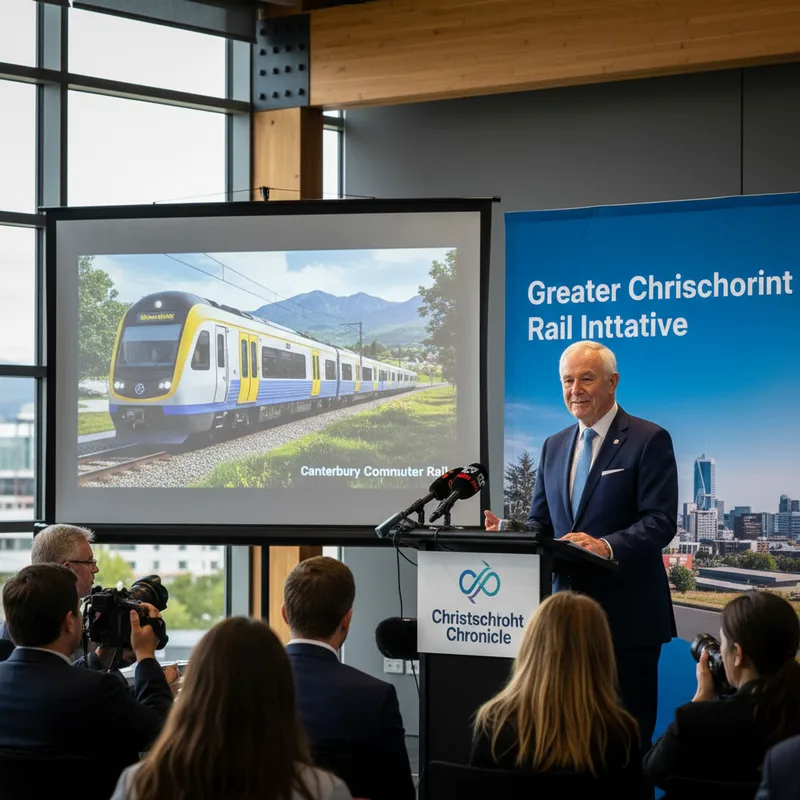
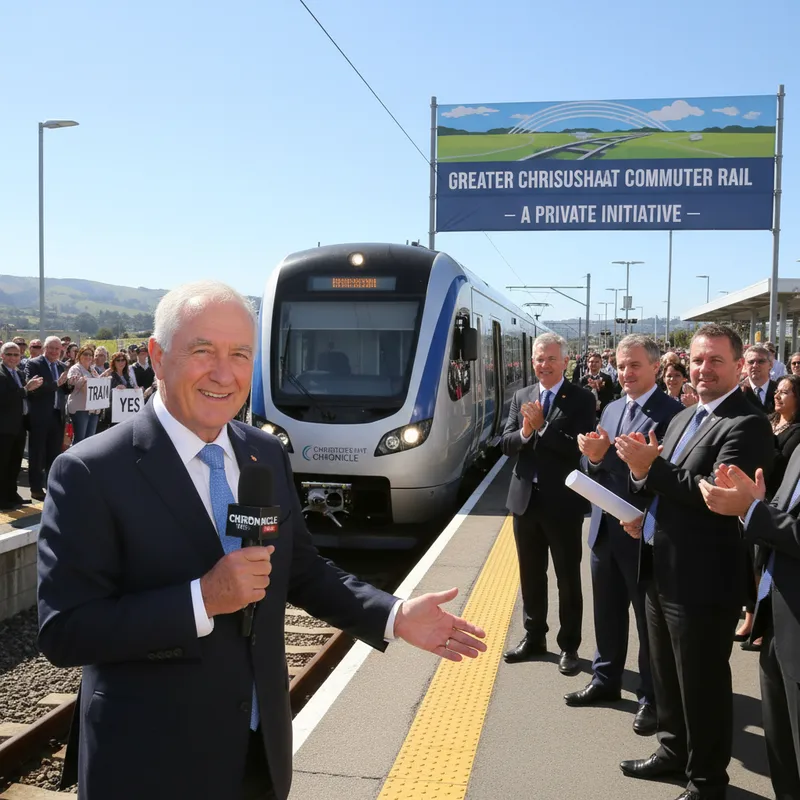
Rail Minister and NZ First leader Winston Peters has praised a private company’s ambitious plan to run a Greater Christchurch commuter rail service, suggesting its approach could teach the North Island a lesson in common sense.
Speaking at the opening of KiwiRail’s new Waltham maintenance facility and locomotive fleet on Friday, Mr Peters commended Mainland Rail for its proactive efforts to build a case for passenger rail without waiting for government “hand outs”.
Over the past few months, Mainland Rail has been running special event services for attendees of major events across Canterbury, including the opening weekend of Te Kaha stadium</a>. The services, from Rangiora and Rolleston to the central city, are designed to demonstrate the viability of and public appetite for a permanent commuter rail network.
Mr Peters, who has served in numerous coalition governments since first entering parliament in the late 1970s, was careful not to offer a specific endorsement of Mainland Rail. However, he confirmed to reporters that a new passenger rail policy would be unveiled before the November elections.
Auckland rail spending criticised
The praise for the Canterbury initiative was paired with sharp criticism of transport projects in the North Island, particularly Auckland's multi-million-dollar spend on a light rail project that has yet to lay “one metre” of track. This contrasts sharply with the Maungawhau housing opportunity grows as CRL station nears opening</a>.
“How do you possibly get away with that waste without being sent to prison?” he asked the crowd of KiwiRail staff and transport industry leaders, highlighting a stark contrast with the privately-driven Canterbury model.
Mr Peters expressed hope that a company like Mainland Rail could operate a commuter service without public subsidy, but conceded it would make sense for one to be provided initially to get the service established. He pointed to Waikato's Te Huia service, where the public subsidy is approximately $84 per trip, as a precedent for government support.
When asked if he would support government funding for the Christchurch project in the next funding round, Mr Peters remained coy but optimistic. “Some talk and some do. Stand back and watch,” he said. “We’ll show you what we’re going to do about this and our support of it well before the election this year.”
'The bones are in the ground'
Among those listening in the audience was Ian Ladd, managing director of Mainland Rail’s parent company, Rail and Tourism Group Holdings. He said he was thrilled by the minister’s comments.
We’re very excited about it. We do believe very much in our cause .. we’d be delighted if we can get the community to trial a commuter service for Rangiora and Rolleston.
Mr Ladd noted that the necessary infrastructure is largely already in place. “The bones are in the ground, so to speak,” he said, referring to the existing rail lines that crisscross the Canterbury plains. He added that while a public subsidy would be welcome to keep ticket prices low for passengers, his company believes it can create an affordable service regardless.
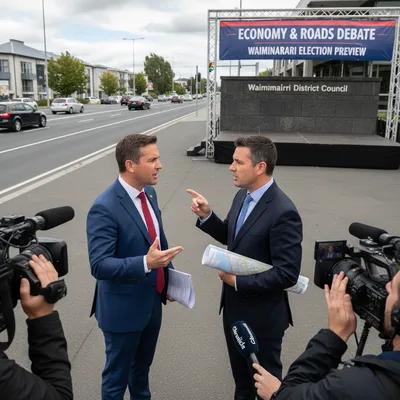
The push for passenger rail comes as the Greater Christchurch area continues to expand, leading to increased traffic congestion and debate over transport solutions. The issue has been a point of contention in local politics, with recent clashes over roading priorities in the Waimakariri district</a> reflecting broader concerns about infrastructure.
Council considers its options
The day before Mr Peters’ speech, Environment Canterbury (ECan) councillors were briefed on the history and future of passenger rail in the region. A commuter service last operated in the 1970s, and while ECan has explored its revival, a 2023 Mass Rapid Transit business case concluded that improved bus services were a more cost-effective short-term solution.
However, the recent acquisition of more rolling stock by Rail and Tourism Group Holdings and the launch of Mainland Rail has injected new momentum into the debate. ECan’s senior strategy manager, Jesse Burgess, confirmed the council is in talks with Mainland Rail. He said they are keenly watching the trial services to gauge public uptake and potential price points for a regular service. The success of large-scale events has helped local Christchurch businesses roar back to life, and reliable transport is seen as a key part of that ongoing recovery.
The event on Friday marked the launch of new DM locomotives and the Waltham Maintenance Hub, part of a $1.2 billion investment into South Island rail since 2019. According to <a href="https://www.kiwirail.co.nz/what-we-do/projects/south-island-fleet/">KiwiRail, $110 million was dedicated to the Waltham facility, which is expected to play a crucial role in transitioning freight from road to rail, reducing emissions and road wear.
Mr Peters suggested the Mainland Rail initiative could be a template for other regions. “It’ll be a good image and example for the North Island to sort themselves out as well,” he said.