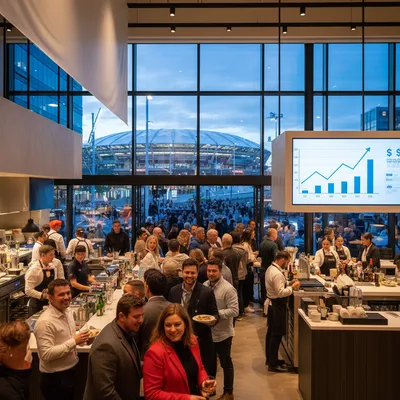
Christchurch’s new One New Zealand Stadium has injected $21 million into the local economy in its first 60 days of operation, a figure that represents nearly half of its forecasted economic impact for an entire year.
The impressive result follows the attendance of 286,000 people across a range of events since the venue opened its doors. The economic data, which tracks the spending of visitors from outside Canterbury, does not even include the additional benefits of local employment and contracts, suggesting the total financial upside for the city is even greater.
Venues Ōtautahi (VŌ), the Christchurch City Council-owned entity managing the stadium, had initially forecast a $50 million economic impact in the venue's first year. Venues Ōtautahi chief executive Caroline Harvie-Teare described the early results as "pretty incredible" during an update to the Christchurch City Council on Wednesday.
The stadium, built for a total of $656.5 million, has been a long-awaited piece of city infrastructure, and its immediate success is being hailed as a significant milestone in Christchurch's post-earthquake recovery. The final cost notably came in $26.6 million under its 2022 budget.
A boost for local businesses
A major feature of the stadium's success is a dramatic increase in spectator spending. Fans attending rugby matches at the new facility are spending double the amount on food and beverages compared to games held at the city's previous venue, the temporary Apollo Projects Stadium in Addington. This surge in spending has directly benefited a host of local food and beverage companies contracted to operate within the stadium, with $1.6 million already paid out to these vendors. Ms Harvie-Teare told the council that these local businesses have, without exception, experienced record turnover from their very first day of trading at the stadium, mirroring the success seen in Brampton where the federal government is investing in local businesses</a>.

“Even if you’re not entirely into what is on the field, people are coming for that other experience,” she said, highlighting the venue's role as a complete entertainment destination.
The list of local suppliers making their mark includes household names such as Smokey T’s, Pedro’s Lamb, Sheffield Pies, Fush, Little Fish Co, Bacon Bros and Black Burger. The scale of their operation is impressive: they have collectively served 2970kg of local beef brisket, 360kg of cheese from Rangiora, 650 slow-cooked Canterbury lamb shoulders, 530 sides of Akaroa salmon, and 6671 Cookie Time cookies. In a memorable illustration of the volume, Ms Harvie-Teare noted that the 3653 litres of sauce used was enough to fill the home team’s plunge pool at the stadium. “It’s kind of a disgusting thing to imagine but still pretty impressive,” she said.
More than just a venue
The stadium's impact extends beyond financial metrics, contributing to a palpable sense of civic pride and optimism. Mayor Phil Mauger shared his enthusiasm at the council meeting, reflecting a widely held sentiment in the city.
The diverse range of events hosted so far demonstrates the venue's versatility. It has held four Crusaders games, a Super Rugby cultural round, the Warriors' historic NRL home game</a>, the multi-artist Once in a Lifetime concert which attracted 37,000 fans, and numerous corporate and business functions.
Growth across the board
Crucially, the stadium's success does not appear to be detracting from Christchurch's other event spaces. Ms Harvie-Teare confirmed that other VŌ-managed venues, including Wolfbrook Arena, the Town Hall, and Hagley Oval, have also hosted a strong calendar of events during the same 60-day period. This suggests an overall expansion of the city's event capacity and appeal, rather than a simple transfer of business from one venue to another.
The new facility has also been a significant source of employment, providing 760 casual staff with 26,945 hours of work across 3839 shifts. VŌ’s overall financial performance for the nine months to 31 March reflects this buoyant activity, with earnings before interest, tax, depreciation and amortisation (EBITDA) reaching $1.24 million. This result is a massive $2.4 million turnaround from a projected loss of $1.16 million and is also $749,000 ahead of the same period last year. The strong performance is attributed to hosting 36 more events, securing $1 million in new commercial partnerships, and achieving lower maintenance costs across the venue network, as detailed on the official Venues Ōtautahi website.
Looking ahead, the demand for tickets remains red-hot. The upcoming All Blacks test match against France on 4 July saw all 30,000 tickets snapped up within just four hours of going on sale, signalling a blockbuster winter season for the city. For those who can't get to a game, behind-the-scenes tours of the stadium are also now on offer, giving the public a chance to explore the world-class facility. The project is seen as a key component in wider urban planning, similar to how other cities are navigating future development, such as the challenges faced in South Dunedin.